
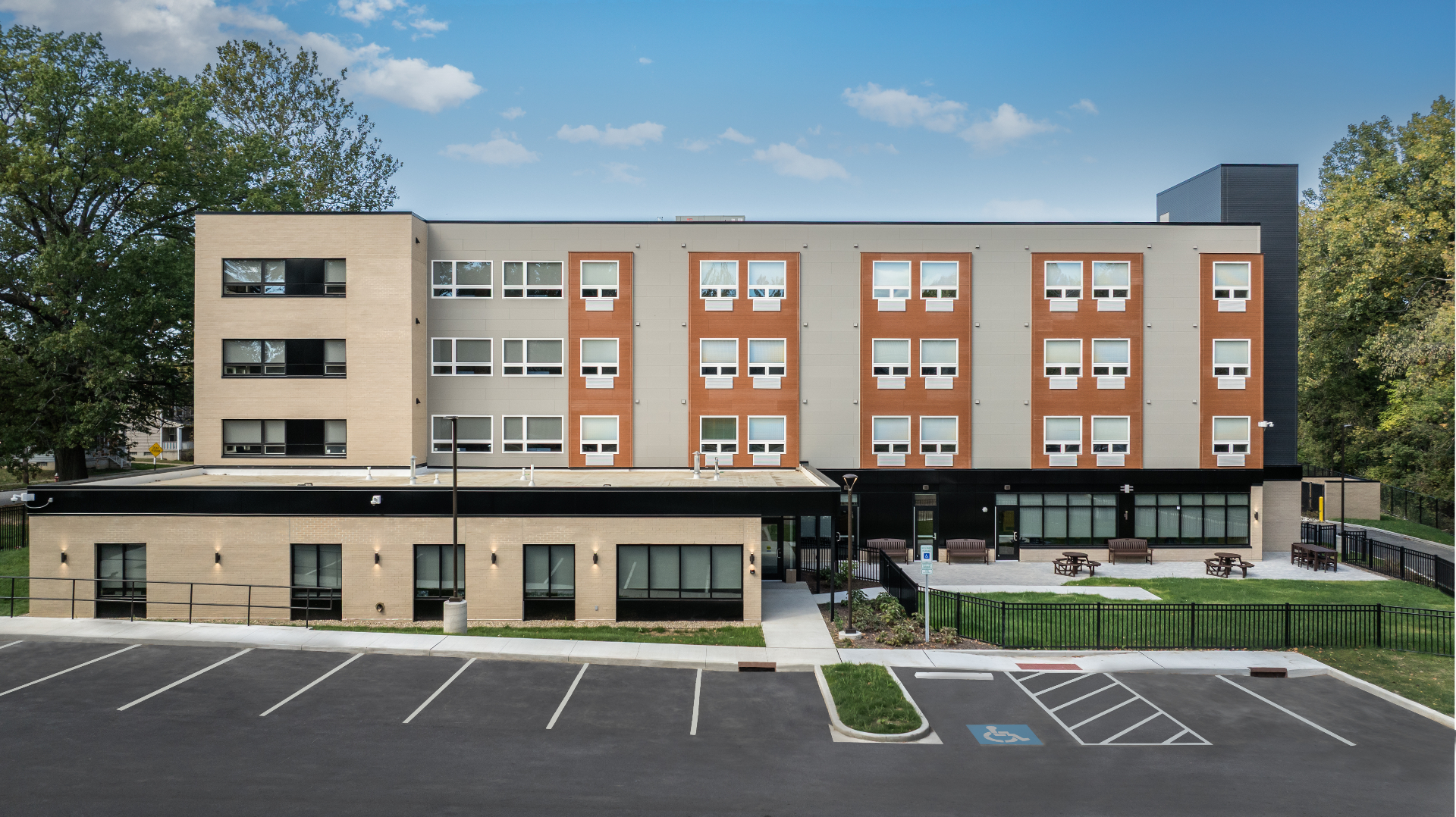
Hitchcock Center for Women
Cleveland, OH
Permanent supportive housing for women and children in recovery.
More than 2,000 children in Cuyahoga County, Ohio are placed with relatives or in foster care at any given time, and about 25% of those cases have mothers who screened positive for illegal substances. That's where the Hitchcock Center for Women & Supportive Services — a blend of long-term permanent supportive housing and a residential treatment center — differentiates itself. It is the only facility in the county that allows children up to the age of 12 to live onsite while their mothers receive treatment. This option prevents children from entering the foster care system and reduces impacts on extended families and costs to the community.
Established in 1978, the Hitchcock Center for Women (HCFW) began as a 10-bed women's halfway house and then moved to its current location. The expansion completed in 2025 doubles the treatment capacity and includes two connected wings in the four-story building — separated by two walls on separate tax lots with separate financing, ownership, and management — that offer 95 units combined. The residential treatment facility with 42 units is owned and operated by HCFW (a nonprofit entity), and the LIHTC building with 53 permanent supportive housing units is co-developed and co-owned by TFG Housing Resources (TFGHR).
All LIHTC units offer project-based rental assistance, are tailored with a preference for women and children, and target households with incomes at or below 30% and 50% of the area median income (AMI). The unit mix includes 30 studios, 21 one-bedroom, and 2 two-bedroom units.
Many of HCFW's clients come from abusive homes, are currently homeless, and/or are responsible for at-risk children. According to the U.S. Department of Health and Human Services, drug use is a factor in 35% of foster care cases, and an estimated 8.7 million children live in households where at least one parent has a substance use disorder.
Located in Cleveland, Ohio, the Hitchcock Center for Women & Supportive Services provides safe, quality housing managed as a sober environment — allowing residents to maintain and greatly improve their chances of recovery and lead to overall stability for hundreds of women and children each year.
A closer look
More from the portfolio
Building something
similar?
Talk with our team about NMTC, LIHTC, RAD, or mixed-use repositioning strategies tailored to your project.